
How to Get to Macau from Hong Kong: Ferry, Bus & Travel Guide
If you’re planning a trip from Hong Kong to Macau, you’ll quickly discover that you have two main options: taking the ferry or travelling by bus across the Hong Kong–Zhuhai–Macau Bridge. We’ve experienced both, so in this guide, we’ll share what it’s actually like travelling from Hong Kong to Macau using each option.
Having taken both the ferry and the bus ourselves, we can give you a first-hand comparison of the journey, including travel times, comfort, convenience and the overall experience. We’ll also walk you through the immigration process, as this is something you’ll need to factor into your journey regardless of which option you choose.
Whether you’re planning a Macau day trip from Hong Kong or staying for a few nights, choosing the right transport can make a big difference to how smoothly your day goes. So, based on our own experience, here’s everything you need to know about getting from Hong Kong to Macau by ferry or bus.
Hong Kong to Macau at a Glance
Getting from Hong Kong to Macau is relatively straightforward, with two main transport options: ferry or bus. We’ve travelled between Hong Kong and Macau using both options, and each has its own advantages depending on your budget, where you are staying and how quickly you want to reach Macau.
The ferry is the traditional option and takes you directly across the water from Hong Kong to Macau. The bus uses the impressive Hong Kong–Zhuhai–Macau Bridge and offers a different experience, including crossing one of the world’s longest sea-crossing bridges.
| Ferry | Bus | |
|---|---|---|
| Journey time | Around 1 hour | Around 1 hour |
| Departure | Hong Kong Island or Kowloon | Hong Kong Port or China Ferry Port Kowloon |
| Arrival | Macau Outer Harbour or Taipa | Macau Port |
| Our experience | Convenient and straightforward | Scenic and easy |
| Best for | Convenience | Budget travellers & bridge views |
Both options require you to go through immigration before entering Macau, so remember to allow additional time at the terminals when planning your journey.
Having experienced both the ferry and bus ourselves, we’ll explain exactly what each journey is like, including the booking process, immigration, travel times and what we would choose depending on the type of trip you’re planning.
How to Get from Hong Kong to Macau by Ferry
Taking the ferry is one of the easiest and most popular ways to travel from Hong Kong to Macau. The journey takes around one hour, and ferries run regularly between Hong Kong and Macau.
The main ferry terminal in Hong Kong is the Hong Kong–Macau Ferry Terminal in Sheung Wan, located inside Shun Tak Centre. It is well connected to the MTR, making it particularly convenient if you are staying on Hong Kong Island.
There are currently two main ferry operators serving the Hong Kong–Macau route: TurboJET and Cotai Water Jet. TurboJET operates services to both Macau Outer Harbour and Taipa, while Cotai Water Jet primarily serves Taipa Ferry Terminal.
Where to Catch the Ferry in Hong Kong
The easiest place to catch the ferry is the Hong Kong–Macau Ferry Terminal at Shun Tak Centre in Sheung Wan. The terminal is directly connected to Sheung Wan MTR Station, making it easy to reach by public transport.
If you’re travelling from Kowloon, you can also reach the Sheung Wan terminal by MTR, or you may find it more convenient to use the China Ferry Terminal in Tsim Sha Tsui, depending on the current service available. However, for direct Hong Kong–Macau services, Sheung Wan is the main terminal to check.
How Long Is the Ferry from Hong Kong to Macau?
The ferry journey takes approximately 60 minutes, although you’ll need to allow additional time for check-in and immigration at the terminal. TurboJET recommends passengers board at least 30 minutes before departure to allow time for document checks.
What Was Our Experience Taking the Ferry?
We found the ferry to be a straightforward and convenient way to get to Macau. Once we arrived at the terminal, the process was relatively simple: we checked in, went through the departure immigration process and then waited for our ferry.
The ferry itself was comfortable, and the journey across the water was fairly quick. For us, the biggest advantage was the simplicity of the journey — there was no need to navigate the Hong Kong–Zhuhai–Macau Bridge or take a connecting bus once we arrived.
One thing we would recommend is allowing more time than just the one-hour sailing time when planning your day. You need to factor in getting to the ferry terminal, checking in, immigration and boarding before you even leave Hong Kong.
Arriving in Macau by Ferry
Depending on the service you choose, you’ll arrive at either Macau Outer Harbour Ferry Terminal or Taipa Ferry Terminal. Both terminals have connections to Macau’s wider transport network, including buses and taxis, while many hotels and resorts also provide complimentary shuttle buses.
If you’re planning to explore Macau’s historic centre, check which terminal your ferry arrives at before booking. If you’re heading towards the Cotai Strip and its famous resorts, Taipa can be particularly convenient.
Our tip: Don’t just choose a ferry based on departure time. Check which Macau terminal you’ll arrive at, as this can make a difference to how easily you can reach your first attraction.
For current sailing times and fares, it’s best to check the operator directly before travelling, as schedules can change.
How to Get from Hong Kong to Macau by Bus
Another option for travelling from Hong Kong to Macau is by cross-border bus via the Hong Kong–Zhuhai–Macau Bridge. Unlike the ferry, this option allows you to travel over the bridge and, depending on the service you book, can take you directly towards your hotel in Macau.
We travelled from China Ferry Terminal in Tsim Sha Tsui, which made the journey particularly convenient for us as we didn’t have to make our own way across Hong Kong to the HZMB Hong Kong Port.
The bus first travelled to the Hong Kong Port, where everyone had to get off to complete Hong Kong immigration. Once we had cleared immigration, we re-boarded the bus and continued across the Hong Kong–Zhuhai–Macau Bridge.
When we reached Macau, we stopped again so that everyone could get off and complete Macau immigration. After clearing immigration, we re-boarded the bus for the final part of the journey, which took us onwards to our hotel.
This made the journey feel much more straightforward than we initially expected. Although there are several stages to the journey, the fact that we were able to stay with the same bus service throughout meant we didn’t have to worry about arranging separate transport between the border crossings and our hotel.
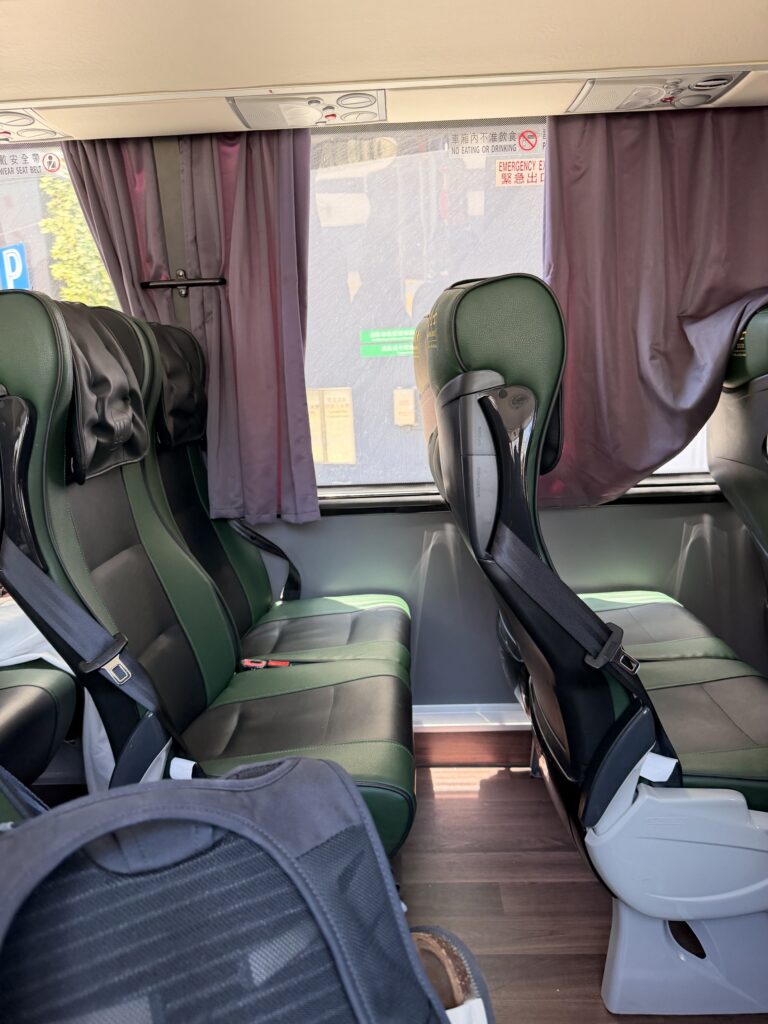
Our Experience Taking the Hong Kong-Zhuhai-Macau Bridge Bus
We decided to take the bus from Hong Kong to Macau so we could experience the Hong Kong–Zhuhai–Macau Bridge for ourselves and compare it with the ferry.
We boarded the bus at China Ferry Terminal in Tsim Sha Tsui, and from there the journey was very straightforward. The bus took us to the Hong Kong Port, where we got off and went through Hong Kong immigration.
Once everyone had cleared immigration, we returned to the same bus and continued across the bridge towards Macau.
On arrival in Macau, we had another immigration stop. Again, we got off the bus, completed the immigration process and then re-boarded. The bus then continued on to our hotel in Macau, which was a huge advantage as we didn’t have to arrange a taxi or another form of transport after arriving.
For us, this was one of the biggest benefits of taking the bus. Although there are two immigration stops, the through-bus service made the overall journey surprisingly easy.
It was also a completely different experience from taking the ferry. Rather than travelling across the water, we got to experience one of the world’s longest sea-crossing bridge systems, and we enjoyed being able to see the bridge and surrounding views along the way.
Hong Kong to Macau Immigration Process
The immigration process is probably the part of travelling from Hong Kong to Macau that can seem the most confusing when you’re planning your journey for the first time.
When we travelled by bus, the process was actually quite simple because the bus service took us directly to each immigration point.
Immigration at the Hong Kong Port
After leaving China Ferry Terminal in Tsim Sha Tsui, our bus travelled to the Hong Kong Port.
Here, we had to get off the bus and go through Hong Kong immigration before entering the bridge crossing. Once we had completed the necessary checks, we returned to the bus and continued our journey.
Immigration at the Macau Port
After crossing the Hong Kong–Zhuhai–Macau Bridge, the bus stopped at the Macau Port.
We once again got off the bus, this time to complete Macau immigration. After clearing immigration, we re-boarded the bus for the final part of our journey.
The great thing about the service we used was that we didn’t have to find another bus or taxi after immigration. We simply got back on the same service and it took us onwards to our hotel.
Our Tips for the Immigration Process
If you’re travelling by bus, don’t be concerned when you’re asked to get off the bus at the ports. This is part of the normal border-crossing process.
We’d recommend keeping your passport and any required travel documents easily accessible and paying attention to the signs and instructions at each port.
Most importantly, allow extra time for immigration when planning your journey. The advertised travel time doesn’t necessarily represent the total time from your hotel in Hong Kong to your hotel in Macau, as you need to account for the two immigration stops as well as the journey to and from the ports.
Ferry vs Bus: Which Is Better?
Having travelled from Hong Kong to Macau using both the ferry and the bus, we were able to compare the two options from our own experience. Both are relatively straightforward, but the experience is quite different.
The ferry is probably the simplest option if you want a quick and direct journey from central Hong Kong to Macau. Ferries are a well-established way to travel between the two destinations, with regular services from the Hong Kong–Macau Ferry Terminal in Sheung Wan.
The bus is a great alternative if you want to experience the Hong Kong–Zhuhai–Macau Bridge. Our bus journey was particularly convenient because we travelled from China Ferry Terminal in Tsim Sha Tsui, stopped at the Hong Kong Port for immigration, crossed the bridge, stopped again at the Macau Port for immigration and then continued onwards to our hotel.
Our Comparison: Ferry vs Bus
| Ferry | Bus | |
|---|---|---|
| Our experience | Quick and straightforward | Easy and more of an experience |
| Journey | Across the water | Across the HZMB |
| Immigration | At the ferry terminals | Hong Kong Port + Macau Port |
| Convenience | ⭐⭐⭐⭐⭐ | ⭐⭐⭐⭐ |
| Experience | ⭐⭐⭐⭐ | ⭐⭐⭐⭐⭐ |
| Best for | A simple journey | Seeing the bridge & travelling to your hotel |
| Our choice | Best for simplicity | Best for the experience |
Why We Preferred the Ferry
For us, the ferry was the better option if your priority is convenience. You arrive at the ferry terminal, complete the required immigration process and board the ferry for the journey to Macau.
There are also different arrival terminals in Macau depending on your ferry service, including Outer Harbour and Taipa, which can be useful depending on where you’re staying.
Why We Enjoyed the Bus
We actually really enjoyed taking the bus across the Hong Kong–Zhuhai–Macau Bridge. It made the journey feel more like part of the adventure rather than simply a way of getting from A to B.
The biggest advantage for us was that our bus continued all the way to our hotel after we had completed immigration in Macau. We didn’t have to figure out another form of transport after reaching the Macau Port.
The downside is that there are two immigration stops, meaning you have to get off and re-board the bus during the journey. However, we found the process straightforward and didn’t think it took away from the overall experience.
So, Which Should You Choose?
If you’re looking for the easiest and most straightforward way to get from Hong Kong to Macau, we’d choose the ferry.
However, if you want to experience the Hong Kong–Zhuhai–Macau Bridge and your bus service offers a through journey to your hotel like ours did, we’d definitely recommend giving the bus a try.
Having done both, we’d say the ferry wins for convenience, while the bus wins for the experience.
How Much Does It Cost to Travel from Hong Kong to Macau?
The cost of travelling from Hong Kong to Macau will depend on whether you choose to take the ferry or travel by bus. We found that both options were reasonably affordable, although the bus can be the cheaper choice if you use the standard HZMB shuttle service.
Hong Kong to Macau Ferry Cost
Ferry prices vary depending on the operator, departure time and whether you travel on a weekday or weekend. As of 2026, Cotai Water Jet standard-class fares from Hong Kong to Taipa start at HK$192 on weekdays and HK$209 on weekends and public holidays, with higher fares for first class and night sailings.
TurboJET fares also vary by sailing. Its current fare information lists direct adult sailings at HK$200 one way, although promotional and non-direct fares may be lower.
For a return journey, therefore, we’d recommend budgeting around HK$400+ per person for a standard-class ferry ticket, depending on your chosen operator and sailing.
Hong Kong to Macau Bus Cost
If you use the standard Hong Kong–Zhuhai–Macau Bridge shuttle bus, the current fare is HK$65 during the daytime and HK$70 at night for a one-way journey.
However, this isn’t necessarily the same bus service we used. We travelled from China Ferry Terminal in Tsim Sha Tsui on a through-bus service that stopped at the Hong Kong and Macau immigration ports before continuing to our hotel. The price of these through services can differ from the standard HZMB shuttle fare.
Which Is Cheaper: Ferry or Bus?
If you’re comparing the standard HZMB shuttle bus with the ferry, the bus is considerably cheaper. At HK$65 during the day, it’s less than half the price of many current standard ferry fares.
However, don’t compare the prices without considering where each service takes you. Our through-bus service was particularly convenient because it continued to our hotel after we completed Macau immigration, whereas with the standard shuttle bus you’d need to arrange onward transport from the Macau Port.
Our tip: If you’re travelling on a budget, check the bus options first. If convenience and a simple journey are your priority, the ferry may be worth the extra cost.
Tips for Travelling from Hong Kong to Macau
Having travelled from Hong Kong to Macau by both ferry and bus, we’ve picked up a few things that are worth knowing before you set off. While the journey itself is fairly straightforward, planning ahead can make the experience much easier.
Allow Extra Time for Immigration
Don’t base your schedule purely on the advertised ferry or bus journey time. You need to allow time for immigration, and queues can vary depending on how busy the ports are.
When we travelled by bus, we had to complete immigration at both the Hong Kong and Macau ports, getting off the bus each time before re-boarding.
Check Your Passport and Entry Requirements
Hong Kong and Macau have separate immigration controls, so you’ll need to go through border formalities when travelling between the two. Make sure your passport is valid and that you meet the entry requirements for Macau before travelling.
Entry requirements can vary depending on your nationality, so check the latest official requirements before your trip.
Decide Between Ferry and Bus Before You Travel
Both options have their advantages.
The ferry is our recommendation if you want the simplest journey, while the bus is a great choice if you want to experience the Hong Kong–Zhuhai–Macau Bridge.
Because we’ve travelled using both, we’d say the decision largely comes down to whether you prioritise convenience or the experience itself.
Check Which Macau Terminal You’ll Arrive At
If you’re taking the ferry, check whether your service arrives at Macau Outer Harbour or Taipa Ferry Terminal.
Where you arrive can make a difference depending on where you’re staying and what you want to see. If you’re visiting Macau for a day, you don’t want to spend unnecessary time travelling across the city after arriving.
Consider Where Your Bus Will Drop You
If you’re travelling by bus, check exactly which service you’re booking and where it will take you.
Our experience was particularly convenient because we travelled from China Ferry Terminal in Tsim Sha Tsui, completed immigration at the Hong Kong Port, crossed the bridge, completed Macau immigration and then continued on the same bus to our hotel.
Not every bus service works this way, so don’t assume that every Hong Kong–Macau bus will take you directly to your accommodation.
Keep Your Passport Easily Accessible
You’ll need your passport during the border-crossing process, so keep it somewhere that’s easy to reach rather than buried at the bottom of your luggage.
This is particularly useful when travelling by bus, as you’ll need to get off at both immigration points.
Don’t Book Your Macau Activities Too Early
If you’re visiting Macau as a day trip, we’d recommend leaving some flexibility in your itinerary, especially for your first activity.
Even though the ferry or bus journey itself may be relatively short, your overall travel time includes getting to the terminal, check-in, immigration and onward transport.
Book Your Return Journey in Advance
If you’re visiting Macau as a day trip, it’s worth thinking about your return journey to Hong Kong before you arrive.
Ferries and buses can become busier at popular times, so having an idea of when you want to return can help you plan your day without rushing.
Take Some Time to Enjoy the Journey
Finally, don’t forget to enjoy the journey itself!
The ferry gives you the chance to cross the water between Hong Kong and Macau, while the bus takes you across the impressive Hong Kong–Zhuhai–Macau Bridge.
Having experienced both, we think they’re both worth trying — and if you’re travelling to Macau more than once, we’d definitely recommend trying both options to experience the difference for yourself.